Journaling can help you process emotions, spot triggers, and strengthen relapse prevention. Start with one of these prompt categories and write for 5 to 15 minutes: gratitude, self-awareness, triggers and cravings, relapse-prevention mooring lines, 12-step inventory, or positive goal-setting. Pick one that fits how you feel right now and begin.
TL;DR:
- Journaling prompts should be tailored to the moment, with quick, focused entries during high-risk situations like cravings, keeping sessions under five minutes.
- Short-term mood dips after writing are normal and typically resolve by the next day, so immediate discomfort doesn’t indicate harm.
- Consistency is more important than frequency, with 15 to 20-minute sessions on scheduled days being most effective for longer-term benefits.
- Private, encrypted journals—whether paper stored securely or apps with strong security—are essential to maintain confidentiality and encourage honest writing.
- Regularly reviewing entries helps identify triggers and reasons for sobriety, but should focus on patterns rather than self-criticism or evidence of failure.
- ✓Encrypted journaling
- ✓Fellowship-specific prompts
- ✓Meeting reminders
- ✓Choice of privacy modes
Table of Contents
- Why journaling helps in recovery
- Prompt categories and when to use them
- Evidence and official guidance on recovery journaling
- Building a journaling habit that actually sticks
- 30 ready-to-use prompts grouped by category
- An author’s note and a simple 7-day starter plan
- Optional: private journaling tools for recovery
- FAQ
- Sources
Why journaling helps in recovery
Writing about difficult experiences helps you build what researchers call a coherent narrative: instead of a jumble of memories and emotions, you get a story with a beginning, middle, and some sense of meaning. A randomized trial of expressive writing among women in residential substance use treatment found greater reductions in posttraumatic symptoms, depression, and anxiety at a two-week follow-up compared to a control group.
A short-term dip in mood is common and usually passes. The same trial found that negative affect increased right after writing sessions but did not persist into the next day. That matters because it means feeling worse immediately after a tough entry is not a sign you did something wrong.
A few safety habits keep this practice useful rather than destabilizing:
- Stop writing and reach out if a prompt brings up distress that feels unmanageable.
- Keep a sponsor, therapist, or trusted contact’s number nearby when you write about trauma or cravings.
- Use quick spot-checks during cravings rather than longer sessions when you’re in a high-risk moment.
Prompt categories and when to use them
Not every moment calls for the same kind of writing. A craving at 11 p.m. needs something fast. A Sunday afternoon of reflection can hold something longer.
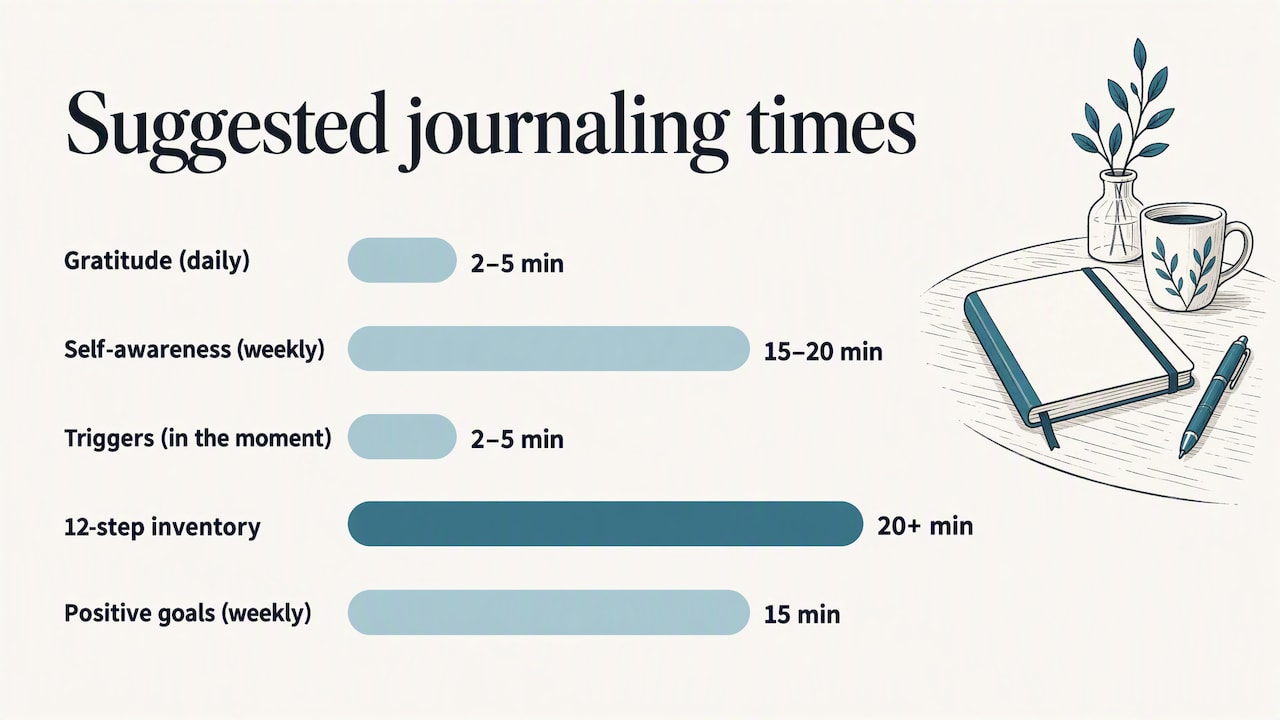
- Gratitude prompts work well as a daily closer, two to five minutes, noting small wins rather than big epiphanies.
- Self-awareness and identity prompts suit a weekly slot of 15 to 20 minutes when you have space to think without rushing.
- Trigger and craving logs are built for the moment itself: two to five lines, just enough to name what’s happening before it passes.
- Relapse-prevention and mooring-line prompts list your concrete reasons for staying sober, reviewed in under five minutes whenever you need a reminder.
- 12-step inventory prompts take the most time, often 20 minutes or more, since they ask you to look honestly at patterns and harms.
- Positive-goal prompts fit a weekly or monthly rhythm, tracking what you’re working toward rather than what you’re avoiding.
When a craving hits, a quick H.A.L.T. check (Hungry, Angry, Lonely, Tired) paired with a two-line spot-check inventory can interrupt the moment before it builds. Practitioners working with relapse-prevention materials recommend these short checklists and reasons-for-sobriety reminders precisely because they’re fast enough to use in the moment, unlike a long, infrequent entry that only happens when you already have an hour free.
- Start with whichever category matches your current state, not the one that sounds most productive.
- Keep spot-checks to under five minutes so they’re sustainable during a crisis.
- Save longer inventory work for a calm, scheduled time rather than a moment of acute craving.
Evidence and official guidance on recovery journaling
SAMHSA guidance describes journaling and storytelling as tools that help people identify compulsive behaviors and triggers, reduce stigma, and encourage help-seeking. That framing lines up with what clinical pilots have found.
A pilot study using four 15-minute writing sessions found the practice acceptable and linked to wellbeing improvements, with many participants rating the exercise as moderately to extremely beneficial. A separate mixed-methods pilot testing a positive-psychology journaling intervention, combining gratitude writing with behavioral activation, found it feasible and acceptable for women in residential treatment, with measurable improvements in wellbeing.
A few practical takeaways follow from this body of work:
- Sessions of about 15 to 20 minutes, repeated over multiple days, appear common in expressive writing protocols.
- Some immediate discomfort after writing is usual and typically fades by the next day.
- Anyone working through trauma-heavy material in writing should have a therapist or counselor involved, especially if distress lasts longer.
Building a journaling habit that actually sticks
A habit survives on realistic expectations, not ambition. Here’s a sequence that works for most people starting out.
- Start with micro-entries, two to three sentences, rather than committing to a full page every day.
- Pick a time that already exists in your routine, like right after coffee or right before bed, instead of inventing a new slot.
- Use spot-checks on hard days and save longer expressive sessions for when you have the energy.
- Decide on your privacy setup before you write anything sensitive: paper kept somewhere secure, or an encrypted app.
- Review old entries monthly, looking for patterns rather than grading yourself.
If you’re deciding between paper and an app, the question is really about who could access your words. Paper is private as long as it’s stored securely, but it isn’t recoverable if lost or damaged. An encrypted app can offer stronger protection, as long as you understand how its encryption actually works. Some apps hold your key on their own servers; others design the system so only your device holds it, meaning even the company can’t read your entries.
When you review old entries, read for mooring lines (the reasons you’re staying sober) and recurring triggers, not for evidence of failure. A messy entry written mid-craving is doing its job even if it reads nothing like a finished essay.
Pro Tip: Date every entry, even a two-line spot-check. Patterns only become visible once you can see them stacked against a calendar.
30 ready-to-use prompts grouped by category
Pick one category below, set a timer, and write without editing yourself.
Gratitude (2 to 5 minutes, daily):
- Name one person who showed up for you this week and why it mattered.
- Write about a small, ordinary moment today that felt good.
- What’s something about your body or health you’re grateful for right now?
- List three things that would have been impossible a year ago.
Self-awareness and identity (15 to 20 minutes, weekly):
- Who are you becoming, separate from who you used to be?
- What part of your old identity are you most afraid of losing?
- Describe a moment this week you felt most like yourself.
- What does a good day actually look like for you now?
Triggers and cravings (2 to 5 minutes, in the moment):
- What am I feeling right now, physically and emotionally?
- Run a quick H.A.L.T. check: am I hungry, angry, lonely, or tired?
- What happened in the ten minutes before this craving started?
- Name one thing I can do in the next five minutes instead.
Relapse-prevention mooring lines (under 5 minutes, as needed):
- List three concrete reasons you’re staying sober today.
- Who would be affected if you relapsed, and how?
- What has sobriety given you that using never could?
12-step inventory (20+ minutes, scheduled):
- Where did resentment show up this week, and what’s underneath it?
- What harm have I caused that I haven’t acknowledged yet?
- Where am I still being dishonest with myself?
- What would a daily spot-check inventory, in the spirit of Step Ten, look like for me tonight?
Positive goals (15 minutes, weekly or monthly):
- What’s one skill or relationship you want to rebuild this month?
- What would progress look like three months from now?
- What’s a small, repairable action you can take for something you regret?
Try one prompt today, then repeat it daily for a week before switching categories.
An author’s note and a simple 7-day starter plan
Journaling won’t replace therapy or a sponsor, but it gives you a place to think out loud when neither is available. A short, consistent practice beats an ambitious one you abandon after three days.
A simple week: days 1 to 2, gratitude only. Days 3 to 4, add one self-awareness prompt. Day 5, try a mooring-line entry. Days 6 to 7, mix spot-checks with a longer inventory prompt. If any entry brings up distress that feels overwhelming, stop and reach out to a therapist, sponsor, or a crisis line such as 988 in the US or Samaritans at 116 123 in the UK and Ireland.
— James
Optional: private journaling tools for recovery
If keeping a paper journal secure feels like one more thing to manage, a dedicated app can hold your prompts, reminders, and entries in one place without you having to build the system yourself. We built 12Steps around that exact need: fellowship-specific prompts, meeting reminders, and journaling tools designed for the pace of actual recovery, not a generic habit tracker repurposed for it.
- In Private mode, entries are encrypted on your device and we hold no key, so we can’t read them.
- In Standard mode, entries are still encrypted on your device, but email password resets mean our server can recover the key, which trades a little privacy for easier account recovery.
- Readers who want extra features or to support ongoing development can check out the Supporter plan.
Whichever mode fits your comfort level, the goal is the same: a place to write honestly without worrying about who else might read it.
This article is general information, not a substitute for advice from a qualified doctor. Consult a qualified healthcare professional about your own circumstances before acting on anything here.
FAQ
Do I have to journal every day for it to help?
No. Research on expressive writing uses sessions spread over several consecutive days, not necessarily daily forever, and even a short spot-check during a craving counts as useful journaling. Consistency over weeks matters more than never missing a day.
What if I don’t know what to write?
Pick a single prompt from one category, gratitude, triggers, or a mooring line, and answer it in two to three sentences without editing. SAMHSA guidance frames journaling as a tool for identifying triggers and patterns, so there’s no wrong way to start as long as you’re writing honestly.
Is journaling a replacement for therapy or a sponsor?
No. Journaling is a personal processing tool, while therapy and sponsorship provide feedback, accountability, and professional support that writing alone can’t replace. Use journaling alongside those supports, not instead of them, especially if a prompt brings up trauma.
Can journaling make me feel worse?
Some people notice a short-term increase in difficult emotions right after writing about hard material, which one trial found resolved by the next day. If distress doesn’t ease or feels unmanageable, stop and talk to a therapist or call a crisis line such as 988 in the US or Samaritans at 116 123 in the UK and Ireland.
How do I keep my journal private?
Store a paper journal somewhere secure, or use an app with real encryption, ideally one where only you hold the key. If privacy is a priority, 12Steps offers a Private mode where entries are encrypted on your device and only you can read them.