Urge surfing is a mindfulness practice that helps you notice a craving, ride it like a wave instead of fighting it, and let it pass without acting on it. Urges typically rise, peak, and fall within minutes. Try this now: breathe slowly for three cycles, then silently name what you feel, “tightness,” “heat,” “pull,” and watch it shift.
TL;DR:
- For a full practice, label the craving, breathe in for four counts and out for six, scan body sensations, then stay through the wave’s crest.
- For intense urges, use the one minute version with grounding or leave the triggering setting; for milder urges, delay a decision for ten minutes.
- A randomized trial of 123 college student smokers found less smoking over seven days after brief instruction, although reported craving intensity did not necessarily fall.
- Practice regularly and track whether you acted, rather than expecting cravings to disappear; seek a doctor or therapist for overwhelming urges or withdrawal risk.
Table of Contents
- What urge surfing is and why it works
- Step-by-step urge surfing technique the reader can follow
- Practical tips, common variations, and when to use them
- Evidence summary: clinical trials and mechanistic findings
- A short guided practice session you can do now
- Learning urge surfing takes repetition, not perfection
- Optional support: how an app can help you build the practice habit
- FAQ
- Sources
- Primary studies, clinical handouts, and manuals referenced
What urge surfing is and why it works
Urge surfing treats a craving the way a surfer treats a wave: something to ride, not something to stop. Instead of pushing the sensation away or giving in to it, you watch it build, crest, and break, trusting that it will pass whether or not you act on it. The term comes from relapse prevention work, where researchers taught smokers to observe cravings as temporary physical events rather than commands that had to be obeyed.
The mindfulness stance underneath this is non-judgmental observation. You are not grading the urge as good or bad, and you are not grading yourself for having it. You are simply watching, the way you would watch weather change. This matters because urges often feel like emergencies that demand an immediate response. Treating them as temporary sensations, rather than instructions, is what breaks the automatic link between feeling a craving and acting on it.
A key distinction drives the whole technique: urge surfing targets your response to the urge, not the urge’s intensity. The sensation itself may not shrink much during a single practice session. What changes with repetition is how you relate to it, so the pull to act loses some of its grip even when the raw feeling sticks around.
Common triggers include:
- Specific places, people, or times of day tied to past use or habit
- Stress, boredom, loneliness, or sudden emotional spikes
- Physical cues like a certain smell, sound, or object
- Social situations where the habit used to feel automatic
Physically, urges tend to show up as a tightening in the chest or throat, restlessness in the hands or legs, a hot or buzzing feeling, or a mental loop that keeps circling back to the same thought. Recognizing these as body sensations, rather than as proof that you must act, is the first move in the practice itself.
Step-by-step urge surfing technique the reader can follow
This sequence works for cravings, compulsions, and anxiety-driven urges alike. Run through it slowly the first few times, then compress it once it feels familiar.
- Recognize. Notice the urge has shown up and name it plainly, in your head or out loud: “This is a craving” or “This is the urge to check my phone.” No judgment, just a label.
- Anchor. Take three slow breaths, in through the nose for a count of four, out for a count of six. Let your breath be the steady point you keep returning to.
- Scan. Ask where in your body the urge lives. Chest, stomach, jaw, hands. Notice its texture: tight, hot, buzzing, heavy. Stay curious rather than trying to fix it.
- Visualize. Picture the sensation as a wave. It rises from a small ripple, builds toward a crest, and eventually breaks and flattens. Most urges peak within a few minutes and fade on their own.
- Ride. Stay present through the crest instead of bracing against it or running from it. Breathe through the peak and use a short self-statement: “This will pass,” or “I don’t have to act on this right now.”
Pro Tip: Set a phone timer before you start so you are not checking the clock, just watching the wave until the alarm tells you time is up.
A 3-to-10-minute mini-practice: Sit somewhere steady, feet on the floor. Spend one minute on the anchor breathing, two to three minutes scanning and visualizing the wave, and the remaining time simply riding it out, breathing, and repeating your self-statement each time the urge spikes again. End by noticing how the sensation compares to when you started, not by expecting it to be gone.
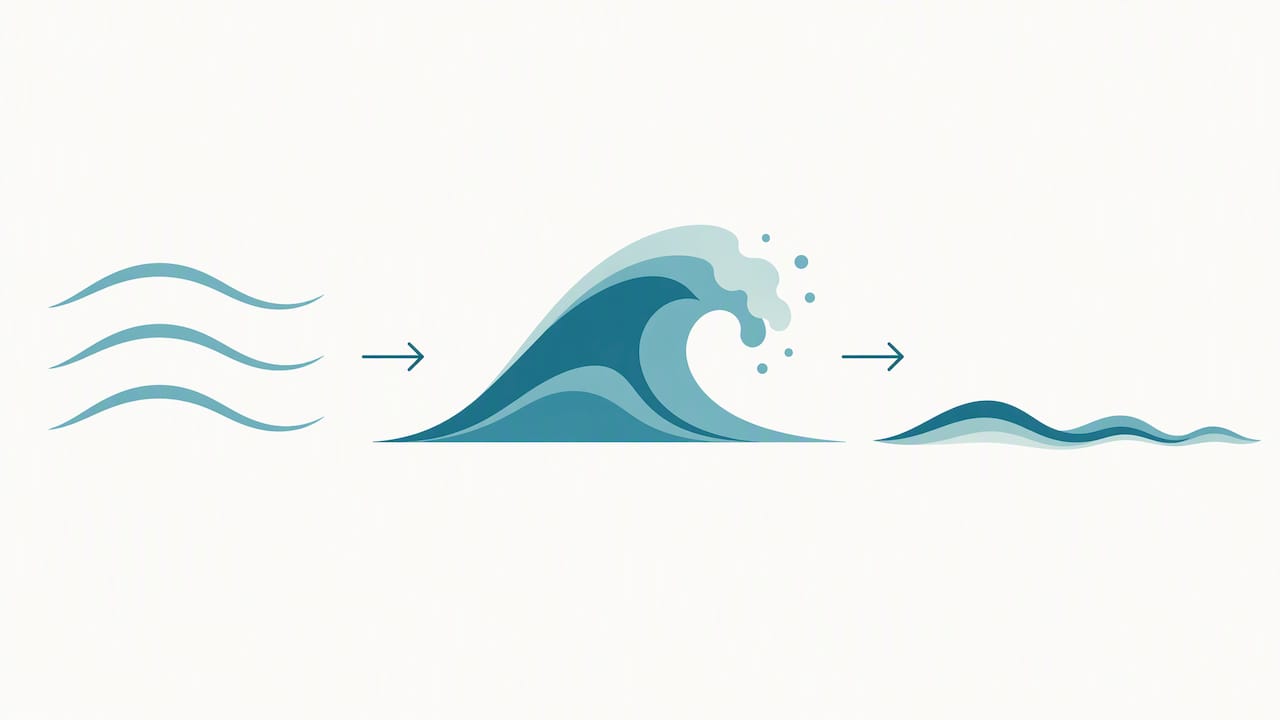
A one-minute variant for public or urgent moments: Take one slow breath. Name the urge silently in one word. Picture it as a wave for ten seconds. Tell yourself “this will crest and drop” and keep moving through whatever you were doing. This shorter version will not feel as deep, but it interrupts the automatic react-and-act pattern long enough for the peak to pass.
The goal across both versions is the same: you are training yourself to stay present through discomfort rather than treating every urge as something that must be resolved immediately by acting on it.
Practical tips, common variations, and when to use them
Urge surfing works best when you adapt the structure to the moment rather than running the same script every time.
RAIN is a related sequence many people layer on top of urge surfing: Recognize what’s happening, Allow it to be there without pushing it away, Investigate the sensation with curiosity, and Note what you learn, then let it go. It pairs naturally with the scan and visualize steps above, giving you a bit more structure when an urge feels confusing or layered with other emotions.
For intense urges, shorten the script. Use the one-minute variant, anchor hard on the breath, and pair it with a grounding move, pressing your feet into the floor, naming five things you can see, or holding something cold. For low-level, nagging urges, a simple delay often works better than a full practice: tell yourself you will wait ten minutes before deciding anything, then check back in once the timer ends. Many people find the urge has already dropped by then.
Common sticking points and fixes:
- Mind wandering: gently return attention to the breath each time you notice it drifted, without criticizing yourself for drifting.
- Sleepiness: practice standing or walking slowly instead of sitting, especially late at night.
- Strong cue exposure (a specific place, person, or object): shorten the script to the one-minute version and pair it with physically leaving the environment if possible.
Urge surfing is not the only tool available, and it works well alongside brief distraction, calling someone, or changing your environment when a craving is tied to a repeated external cue. None of these approaches replaces the others. Riding the wave teaches you to tolerate the sensation in the moment, while changing your surroundings reduces how often that wave shows up in the first place.
Evidence summary: clinical trials and mechanistic findings
The founding trial on this technique, Bowen and Marlatt’s 2009 study, randomized 123 college student smokers after a cue-exposure session and found that brief urge-surfing instruction reduced smoking behavior over the following 7 days, even though reported urge intensity did not necessarily drop. That gap matters: the practice changed what people did with the craving more than it changed how strong the craving felt.
Later research extended this pattern. A smartphone-based mindfulness training trial for smoking cessation found that app-delivered mindfulness training reduced the link between craving and smoking behavior in some samples, suggesting the skill can transfer outside a therapist’s office. Separately, laboratory work on mindfulness- and reappraisal-based regulation of craving found that mindful acceptance and cognitive reappraisal reduced cue-induced craving in controlled experiments, pointing to training-specific effects rather than general relaxation.
- Brief, single-session urge-surfing instruction has been linked to reduced smoking behavior over the following week, even without a parallel drop in reported urge strength.
- App-based and lab-based mindfulness training both show measurable effects on the connection between craving and acting on it, not just on how cravings feel.
A single randomized trial found that brief urge-surfing instruction reduced smoking behavior over 7 days in college student smokers, even though urge intensity itself did not necessarily decrease. That is the realistic expectation to carry into practice: you are training your response, not expecting the craving to vanish on command.
Mechanistic commentary, including work summarized by researchers discussing mindfulness and craving, points to curiosity and attentive observation as the active ingredients, creating space between a sensation and an automatic reaction. This lines up with what the trials show behaviorally: regular practice seems to loosen the grip of the urge on your actions well before it loosens the grip on how the urge feels.
A short guided practice session you can do now
Find a seat or a spot to stand still for a few minutes.
- Settle (20 seconds): Feet flat, shoulders down, eyes open or closed.
- Breathe (30 seconds): Three slow cycles, in for four counts, out for six.
- Scan (1 minute): Locate the sensation. Name its qualities: tight, warm, buzzing.
- Visualize (1 to 2 minutes): Picture it as a wave rising. Watch for the crest.
- Ride (1 to 2 minutes): Stay with it as it peaks and begins to drop. Repeat “this will pass” as needed.
- End: Take one more breath and notice what changed, if anything.
For a standing or walking version, shorten each step by half and let your footsteps replace the stillness. If a phone notification triggers the urge, pause before opening the app, run the one-minute variant, then decide. Afterward, jot down the urge’s intensity on a 0 to 10 scale and whether you acted. That small log, kept over weeks, usually shows change even when the peak feeling stays similar.
Learning urge surfing takes repetition, not perfection
Urge surfing felt clumsy the first several times I tried walking someone through it. The breathing felt forced, the “wave” metaphor felt abstract, and the urge did not politely disappear on command. That is normal, and it is not a sign the technique is failing.
What seems to matter more than any single session is repetition: short practices, done often, logged honestly. Track whether you practiced and what you noticed, not whether the urge hit zero. Over weeks, the pattern usually shifts even when the peak feeling does not.
If urges feel consistently overwhelming, come with sudden intensity, or are tied to a substance that carries withdrawal risk, that is a signal to bring in a doctor or therapist alongside anything you practice on your own.
— James
Optional support: how an app can help you build the practice habit
Consistency is easier with small supports: a reminder to practice, a private place to log an urge’s intensity, and a prompt to notice patterns over time. We offer a private recovery app with encrypted journaling, meeting reminders, and daily prompts that can sit alongside urge surfing practice, never in place of professional care when that is what you need. If you want a tool to support the habit, see the 12Steps app or the Supporter plan at £12 per year.
This article is general information, not a substitute for advice from a qualified doctor. Consult a qualified healthcare professional about your own circumstances before acting on anything here.
FAQ
How do you properly urge surf?
Name the urge without judgment, anchor on a few slow breaths, scan your body for where the sensation sits, then picture it as a wave that rises, peaks, and falls while you stay present through the crest. The founding trial found this reduced smoking behavior over the following week even when the craving itself did not shrink much during the exercise.
What is the ten-minute rule for urges?
The ten-minute rule asks you to delay any decision for ten minutes once an urge appears, since many urges fade or weaken substantially within that window without any action needed. It pairs well with urge surfing: use the full technique for strong urges, and the simple delay for milder ones.
How can I surf my urge in the moment?
Use the one-minute version: one slow breath, a silent one-word label for the urge, ten seconds imagining it as a wave, then a short reminder that it will crest and drop. This shorter form will not feel as deep as a full practice, but it is often enough to interrupt an automatic reaction.
How do I fight the urge to act?
Rather than fighting the urge directly, which tends to increase its intensity, mindfulness-based approaches like urge surfing aim to let the sensation move through you while you keep from acting on it. Laboratory research on craving regulation found that mindful acceptance and reappraisal reduced cue-induced craving more effectively than resistance alone.
Is urge surfing backed by research?
Yes, starting with a 2009 randomized trial in college student smokers and extending into app-based and laboratory studies on mindfulness and craving regulation. The consistent finding across this work is a change in behavior and in the craving-to-action link, more than a drop in how strong the urge feels in the moment.
Sources
- Surfing the urge: Brief mindfulness-based intervention for college student smokers
- Craving to Quit: A Randomized Controlled Trial of Smartphone App–Based Mindfulness Training for Smoking Cessation
- Randomized trial of mindfulness- and reappraisal-based regulation of craving training among daily cigarette smokers
- Tobacco & Nicotine Treatment Group Counseling Toolkit (VA)
Primary studies, clinical handouts, and manuals referenced
- Surfing the urge: Brief mindfulness-based intervention for college student smokers, the original randomized trial behind the technique.
- Craving to Quit: Smartphone App-Based Mindfulness Training, evidence that app-delivered practice can carry similar effects.
- Randomized trial of mindfulness- and reappraisal-based regulation of craving training, laboratory evidence on mechanisms.
- Tobacco & Nicotine Treatment Group Counseling Toolkit (VA), a clinical manual with structured scripts and worksheets.